
Key takeaways
Unified eConsent and EDC
Clinical trial sites manage a wide range of responsibilities, from supporting participants through informed consent to collecting study data, maintaining documentation, and responding to sponsor and CRO requests. When these activities rely on separate technology systems, even routine tasks can require additional coordination.
Electronic informed consent (eConsent) and electronic data capture (EDC) are closely related parts of clinical trial execution. Yet when they operate in separate applications, site staff may need to manage participant information, consent records, and study activities across different workflows.
Bringing eConsent and EDC together within a unified eClinical platform can help reduce these administrative demands. By making consent information and study data accessible within one environment, research teams can simplify everyday activities while maintaining appropriate oversight of the informed consent process.
Where Separate eConsent and EDC Systems Create Additional Work
Electronic consent and data capture systems serve different purposes. eConsent supports the process of presenting study information, documenting informed consent, and managing consent records. EDC supports the collection, review, and management of clinical research data.
Although these processes are distinct, they frequently involve the same participants and study teams.
When eConsent and EDC are managed through separate applications, several operational challenges can arise.
- Duplicate information and reconciliation: Participant details or identifiers may need to be entered or maintained across systems. Without appropriate integrations, changes can require additional reconciliation to maintain consistency.
- Limited visibility across workflows: Site personnel may need to check one application for consent status and another for study data or participant activities. This can complicate oversight, particularly when multiple participants are at different stages of enrollment and data collection.
- Additional training and support: Staff may need to learn different interfaces, manage separate credentials, and follow multiple system-specific procedures. Technical issues can also require coordination between vendors.
- More complex change management: Protocol amendments, revised consent documents, or changes to study procedures may require updates across multiple applications and workflows.
Separate systems can work effectively when they are properly integrated and supported by clear procedures. However, the additional coordination they introduce is an important consideration when evaluating technology for clinical trial sites.
How Unified eConsent and EDC Support Site Workflows
Combining consent and data collection capabilities within one platform can simplify several activities that site teams perform throughout a study.
1. Reducing Duplicate Data Entry and Reconciliation
Managing participant information across multiple systems can create opportunities for discrepancies, particularly when information is entered manually or updated in more than one location.
A unified eConsent and EDC platform can support shared participant workflows, reducing the need to maintain certain information separately.
This can be particularly useful during enrollment, when site staff may be managing consent documentation, participant registration, eligibility activities, and the transition into ongoing study data collection.
Reducing unnecessary duplication allows sites to spend less time coordinating information between applications. The actual efficiency gains depend on how the study is configured and which data elements are shared across workflows.
2. Improving Visibility Into Consent Status
Informed consent is an essential part of clinical trial conduct, and site teams need reliable information about whether the appropriate consent process has been completed and documented.
When consent information is managed in a separate application, staff may need to switch systems to verify consent status or retrieve relevant documentation.
Unified eConsent and EDC workflows can give authorized users access to consent information alongside other study activities. This helps teams monitor participant progress and identify situations requiring follow-up.
For example, staff may need to determine whether a participant has completed the applicable consent process before proceeding with study-specific assessments. Having consent information readily accessible can support that review and reduce unnecessary coordination.
These workflows must still account for the study’s protocol, applicable regulations, and institutional review board (IRB) requirements. Technology supports the process, while investigators and authorized study personnel remain responsible for carrying it out appropriately.
3. Managing Consent Updates and Reconsent
The informed consent process extends beyond a participant’s initial signature.
Protocol amendments, new safety information, or other study changes may require revised consent materials and, when applicable, reconsent from participants.
For sites, this can introduce additional administrative work. Staff may need to identify affected participants, distribute updated materials, document consent activities, and verify that the appropriate version has been completed.
An electronic consent system can help organize these activities through consent version management, digital documentation, and participant status tracking.
When eConsent is part of a unified platform, sites can manage these activities within the same environment used for other study workflows. This can improve visibility into outstanding consent activities and reduce the need to coordinate information across separate applications.
The FDA’s guidance on the use of electronic informed consent in clinical investigations provides additional considerations for presenting consent information, obtaining and documenting informed consent, and using electronic systems appropriately.
Regardless of the technology used, research teams must follow applicable requirements for revised consent information and documentation.
4. Simplifying Training and Technical Support
Clinical trial sites often work with multiple sponsors, CROs, and technology providers. Each study may introduce its own systems, training requirements, and operating procedures.
Managing separate eConsent and EDC applications adds to that technology workload.
A unified environment can reduce the number of interfaces staff must learn and the number of vendors involved in supporting related workflows. It may also simplify user access management and technical troubleshooting.
These benefits are particularly relevant when sites are managing several studies at once or onboarding new personnel.
Even within a unified platform, study-specific training remains necessary. Sites must still understand the configured consent process, data collection requirements, and procedures for identifying and resolving issues.
The advantage is the opportunity to manage related activities through a more consistent technology environment.
Separate vs. Unified eConsent and EDC: A Site Workflow Comparison
The differences between separate and unified systems become clearer when considering the activities site personnel perform throughout a study.
| Site activity | Separate eConsent and EDC systems | Unified eConsent and EDC platform |
|---|---|---|
| Participant information | May require duplicate entry or integration between applications | Can support shared participant information and workflows |
| Consent status | Staff may need to access a separate application | Consent information can be accessible alongside relevant study records |
| Consent updates and reconsent | May require coordination across applications | Can be managed within the same environment as other study activities |
| Data reconciliation | May require checks between systems, depending on integration | Can reduce reconciliation associated with transferring shared information |
| Staff training | Separate interfaces and procedures may be required | A more consistent application environment can simplify training |
| Technical support | Troubleshooting may involve multiple vendors | A single platform provider can simplify support coordination |
The specific differences depend on system configuration, integration capabilities, and study requirements. A unified platform can reduce operational complexity, but appropriate procedures, validation, and oversight remain necessary.
What Should Sites Look for in an eConsent and EDC Platform?
For sponsors and CROs evaluating technology on behalf of their sites, the goal should be to support the activities research teams perform throughout the study.
Several considerations are particularly relevant.
- Consent lifecycle management: The platform should support the study’s requirements for consent presentation, documentation, version management, and reconsent.
- Appropriate participant access: Participants should be able to access consent materials through methods suited to the study population, with options that accommodate site-based, remote, or hybrid processes where appropriate.
- Visibility and oversight: Authorized personnel should be able to review consent activities, monitor relevant participant status, and retrieve documentation needed for study oversight.
- Data integrity and traceability: Audit trails, electronic signature controls, role-based access, and appropriate record management capabilities should support applicable regulatory requirements.
- Flexible study workflows: The technology should accommodate protocol-specific requirements and changes without introducing unnecessary administrative work.
- Support for sites: Training, documentation, and responsive technical support remain important, particularly when studies involve multiple locations or complex operational requirements.
Electronic systems used in regulated clinical investigations must be evaluated in the context of their intended use. The requirements of 21 CFR Part 11, where applicable, and other relevant regulations should be considered when establishing electronic record and signature processes.
Technology selection is only part of effective implementation. Study teams also need clear procedures and appropriate training to support consistent execution.
How TrialKit Supports Unified eConsent and EDC Workflows
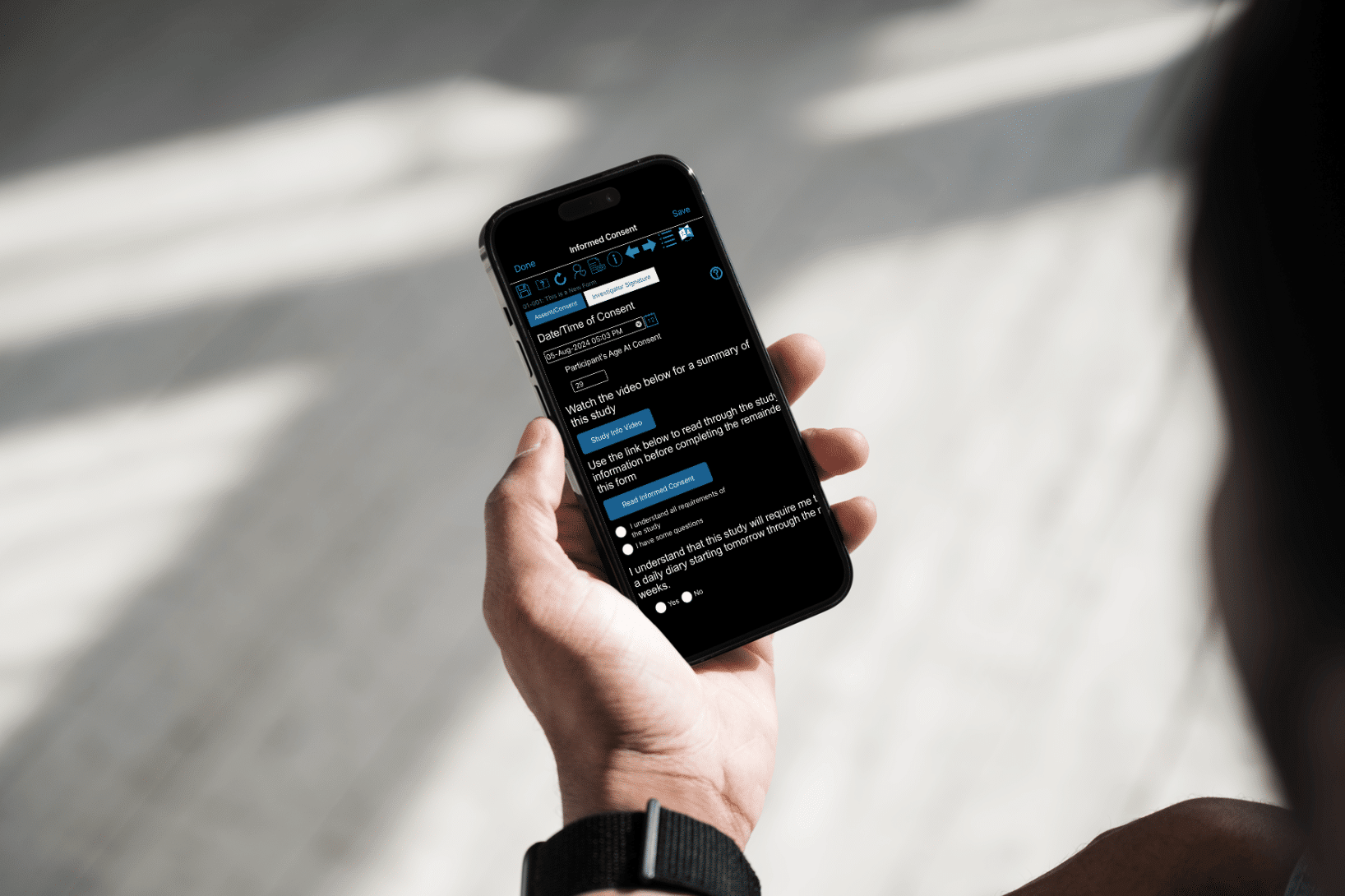
Crucial Data Solutions’ TrialKit brings eConsent and EDC together within a unified eClinical platform, allowing sponsors, CROs, and research sites to manage consent and clinical data collection as related parts of the study lifecycle.
TrialKit eConsent supports electronic consent forms, participant signatures, consent documentation, and reconsent workflows. Participants can review consent materials remotely or during site visits, while authorized study personnel can access relevant consent information and records through TrialKit.
The platform’s EDC capabilities support configurable electronic case report forms, data validation, query management, reporting, and ongoing data review. Role-based permissions and audit trails provide additional controls for managing study information.
With consent and clinical data collection available in the same environment, study teams can coordinate related participant activities without maintaining entirely separate applications for these functions.
TrialKit also incorporates Floyd, its AI model, to support study development and validation. Floyd can help teams interpret protocol requirements and generate study components, including eCRFs, visit schedules, and related logic. Synthetic participant simulation and validation capabilities provide additional ways to evaluate configured workflows before live data collection begins.
These capabilities can help sponsors and CROs prepare and manage study configurations while keeping clinical and operational experts responsible for reviewing requirements and approving the resulting workflows.
For sites, the broader value of TrialKit’s unified approach is the ability to access relevant consent and data collection capabilities within one study environment, with fewer separate systems to manage.
Reducing Site Burden Through Better Workflow Design
Clinical trial sites play an essential role in participant protection, informed consent, and reliable data collection. The technology supporting these responsibilities should account for the practical demands of conducting a study.
Separate eConsent and EDC systems can introduce additional steps for managing participant information, checking consent status, coordinating updates, and supporting staff. Integrations can help address these challenges, while unified platforms offer another approach by bringing related capabilities together.
Reducing unnecessary administrative work can give site teams more time to focus on participant communication, study procedures, and data review.
For sponsors and CROs, evaluating eConsent and EDC together provides an opportunity to consider how technology choices affect the research sites responsible for executing the protocol.
Simplify eConsent and EDC With TrialKit
See how TrialKit’s unified eClinical platform can help your team manage informed consent, clinical data collection, and related study workflows in one environment. Request a demo today.