

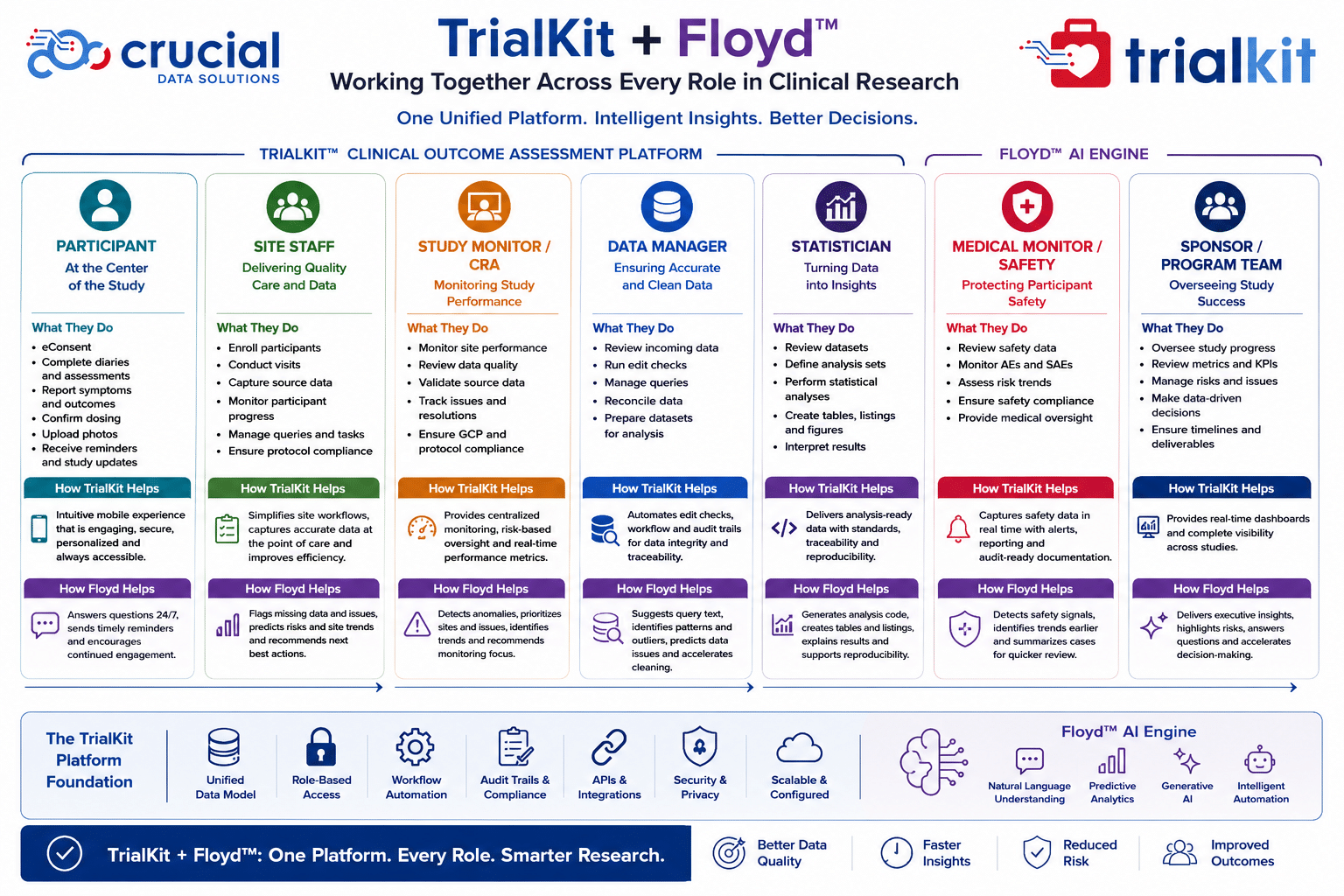
A protocol may define how a clinical study should operate, but turning those requirements into a working study still requires extensive configuration, testing, and refinement. AI embedded within the eClinical platform can help teams move through that work more efficiently by translating requirements into study components, testing how those components behave, and making study data easier to investigate throughout execution.
TrialKit AI, powered by TrialKit’s AI model Floyd, was built for this role. Because Floyd operates within the TrialKit eClinical platform, it understands TrialKit’s APIs, backend data model, study architecture, and the relationships among protocols, forms, visits, workflows, and study data. That context allows it to support the work inside the same platform teams use to build and manage their studies, with output that can be reviewed and applied directly within the study environment.
Exploring Study Behavior Before Enrollment
Once the initial configuration is in place, teams can test how it behaves across realistic study scenarios. Floyd can generate synthetic participants and corresponding study data, allowing teams to exercise edit checks, calculations, required fields, visit schedules, workflows, and protocol logic before enrollment begins.
Teams can also explore how the study performs across different participant profiles or treatment arms and see how connected elements respond over time. Synthetic data gives reviewers a broader set of realistic conditions to examine, including scenarios that may be difficult or time-consuming to create manually. This gives teams more information to work with as they confirm the configuration, focus validation activities, and align clinical, data, technology, and operational stakeholders.
Putting Study Data to Work
TrialKit AI continues to support the team after study startup. As data accumulates, authorized users can ask natural-language questions about participant activity, site performance, protocol compliance, data quality, and operational trends. Users can investigate a question directly and then follow the result into a more focused review. The analysis reflects TrialKit’s study architecture, including its forms, visits, endpoints, workflows, and protocol logic, so the answers remain connected to how the study is structured.
Teams can also compare synthetic expectations with live study data as execution progresses. These comparisons can highlight emerging patterns, show where actual performance differs from modeled expectations, and point teams toward areas that deserve a closer look. They can also help teams revisit earlier assumptions as real participant and site data become available. Clinical and operational experts then apply their knowledge of the study to interpret the findings and decide what action to take.
Combining AI with Human Expertise
Clinical trials bring together scientific goals, participant needs, regulatory responsibilities, and operational realities. Experienced professionals understand how those factors affect one another, and their judgment remains central to study design and execution. TrialKit AI supports that judgment by giving teams faster access to structured study builds, realistic test scenarios, and useful data insights.
The division of work is straightforward. Floyd can process large volumes of information, maintain consistency across connected components, and explore scenarios quickly. Study professionals bring therapeutic knowledge, operational experience, ethical judgment, and an understanding of the people represented by the data. Teams can review and refine what Floyd produces at every stage, from the initial study build through analysis of live data. They remain responsible for interpreting the output, placing it in context, and deciding how it should affect the study.
A Digital Teammate Built for Clinical Research
AI becomes more useful when it can contribute directly to the work and understand the system where that work happens. For clinical research, that means supporting study building, simulation, validation, and analysis while understanding how protocols, forms, visits, workflows, and data fit together.
TrialKit AI brings those capabilities into one eClinical platform. Floyd can help teams turn protocol requirements into a working study foundation, populate the study with synthetic participants, test its behavior before enrollment, analyze live data, and compare actual performance with modeled expectations. This gives research teams a practical way to use AI across the study lifecycle while keeping experienced professionals involved in review, interpretation, and decision-making.
See how TrialKit AI, powered by Floyd, can help your team build, test, and analyze clinical studies within one eClinical platform. Contact Crucial Data Solutions to request a demo.